DEEPX Connects With Open Ecosystems of Millions of Developers, Aims to Set the Standard for Running Physical AI
DEEPX is linking its NPUs with global developer ecosystems such as Ultralytics YOLO, PaddlePaddle and Raspberry Pi to build an open physical AI ecosystem.
- DEEPX NPUs connect with global software and hardware developer ecosystems, from Ultralytics YOLO and PaddlePaddle AI models to Raspberry Pi
- "Our goal is to go beyond supplying chips and build a global open physical AI platform"
July 14, 2026 — DEEPX, a developer of ultra-low-power on-device AI semiconductors, is stepping up efforts to build a developer-centered open physical AI ecosystem by expanding its ties with global AI model and developer platforms.
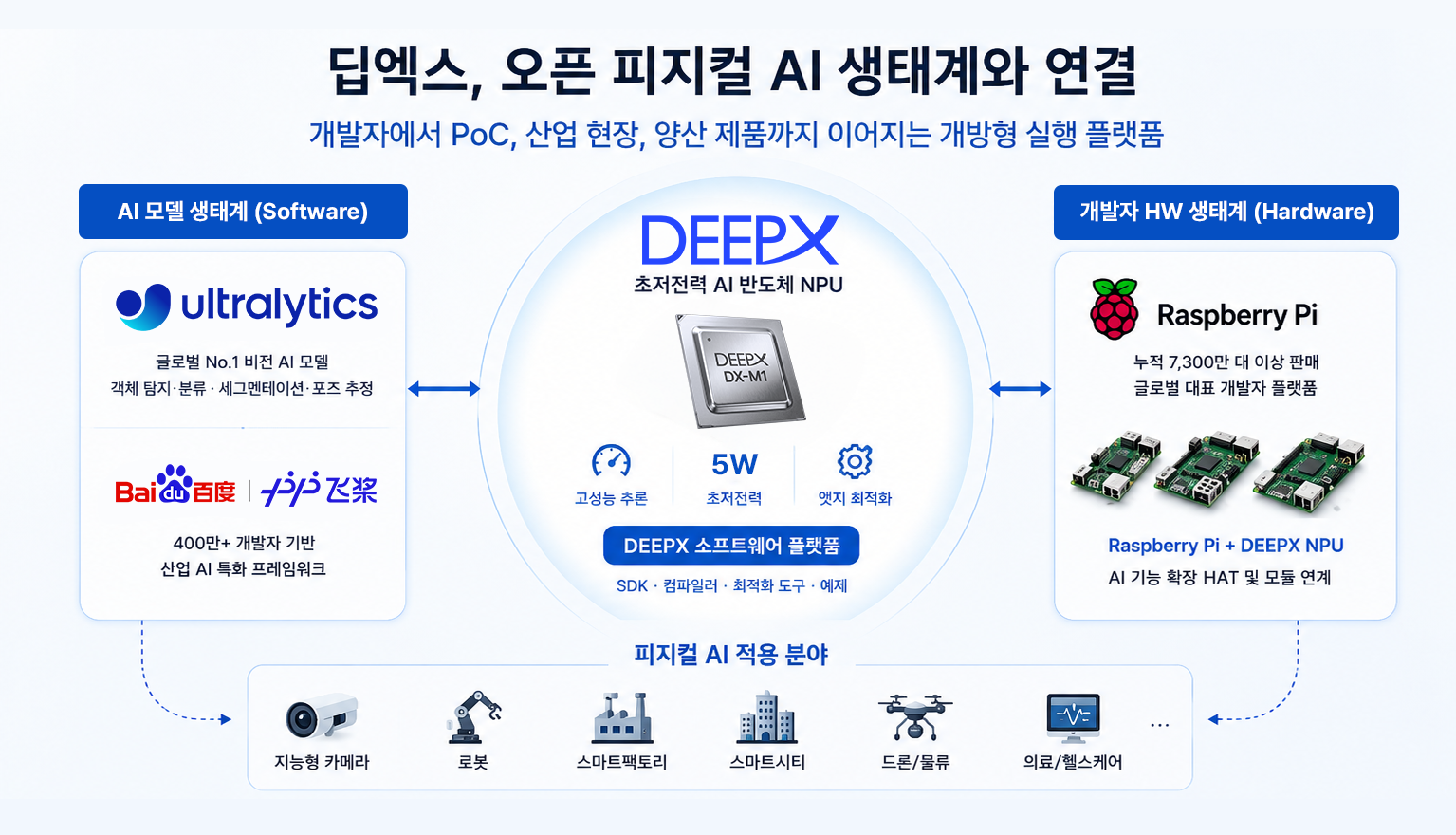
The strategy is to connect global software and hardware ecosystems such as Ultralytics YOLO, PaddlePaddle and Raspberry Pi with DEEPX's NPUs, creating a runtime environment that carries projects from development through proof of concept (PoC) to industrial mass production.
"In the age of physical AI, one good chip is not enough. Developers need a complete ecosystem in which they can build models, validate them on hardware and deploy them in real industrial settings. Going beyond supplying chips, DEEPX is stepping up efforts to build an open physical AI ecosystem that connects developers, AI models and hardware, creating an open runtime platform that helps developers and companies around the world bring physical AI to life more easily and quickly." — Lokwon Kim, CEO, DEEPX
Physical AI is technology in which AI directly perceives, decides and controls within real-world devices such as robots, intelligent cameras, industrial equipment and smart factories. By connecting AI model ecosystems with its ultra-low-power NPUs, DEEPX is building a runtime environment in which developers can easily take AI they built in familiar tools all the way to real industrial sites.
Linking NPUs With Three Major Global AI Developer Ecosystems
1. Connecting With Ultralytics YOLO, a Global Vision AI Ecosystem
Ultralytics YOLO is one of the most widely used model ecosystems for real-time vision AI. It is used across industries including intelligent cameras, robotics, smart factories, autonomous driving, retail, health care and logistics, and YOLOv8 recorded 5 million users and 15 billion events within a year of its release.
DEEPX formed a strategic alliance with Ultralytics in May. Developers can keep using familiar YOLO models while running high-performance, ultra-low-power AI inference on Raspberry Pi and other systems, as well as robots, intelligent cameras and industrial equipment.
Previously, AI models had to go through separate conversion and optimization after training. With this integration, developers can scale straight from a familiar development environment to edge AI systems.
2. Partnering With PaddlePaddle, With More Than 4 Million Developers
PaddlePaddle is a global open-source deep learning framework with more than 4 million developers, known for its strengths in industrial AI and real-world deployment.
Since partnering with PaddlePaddle in August last year, DEEPX has been pursuing industrial AI projects and joint product development. As a result, the company applied PaddlePaddle's lightweight PP-OCRv5 model to DX-M1, its M.2 AI accelerator rated at up to 25 TOPS, creating an environment in which PaddlePaddle-based AI models run efficiently on DEEPX NPUs.
This environment can be used in industries that need real-time AI inference, such as OCR, robotics, drones and smart cities.
3. Joining the Raspberry Pi Ecosystem, With 73 Million Units Sold
Through its link with the Raspberry Pi ecosystem, which has sold more than 73 million units, DEEPX has also secured a hardware foundation that lets developers around the world experiment with physical AI firsthand.
In June, DEEPX launched an AI accelerator module for Raspberry Pi 5 and began selling it to AI developers and educators worldwide. Developers can validate AI features on Raspberry Pi using Ultralytics or PaddlePaddle models and then scale them into real products such as industrial cameras, robots, edge gateways and smart factory equipment.
If Raspberry Pi is the starting point for experimenting with physical AI ideas, DEEPX NPUs serve as the ultra-low-power AI engine that runs them in real industrial settings.
From Developers to PoC and Industrial Mass Production
The focus of DEEPX's strategy is a pipeline that connects the developer experience to PoCs and industrial mass production.
The company aims to lower the barriers to adopting physical AI by supporting a path in which developers build AI applications on Raspberry Pi, companies and research institutions validate them through PoCs, and the results scale into industrial products.
To that end, DEEPX plans to link AI model ecosystems, developer hardware, ultra-low-power NPUs, SDKs and industrial reference designs, and to keep expanding hands-on examples and field validation programs for companies, strengthening a global open physical AI ecosystem that runs from development to PoC to industrial mass production.
Related
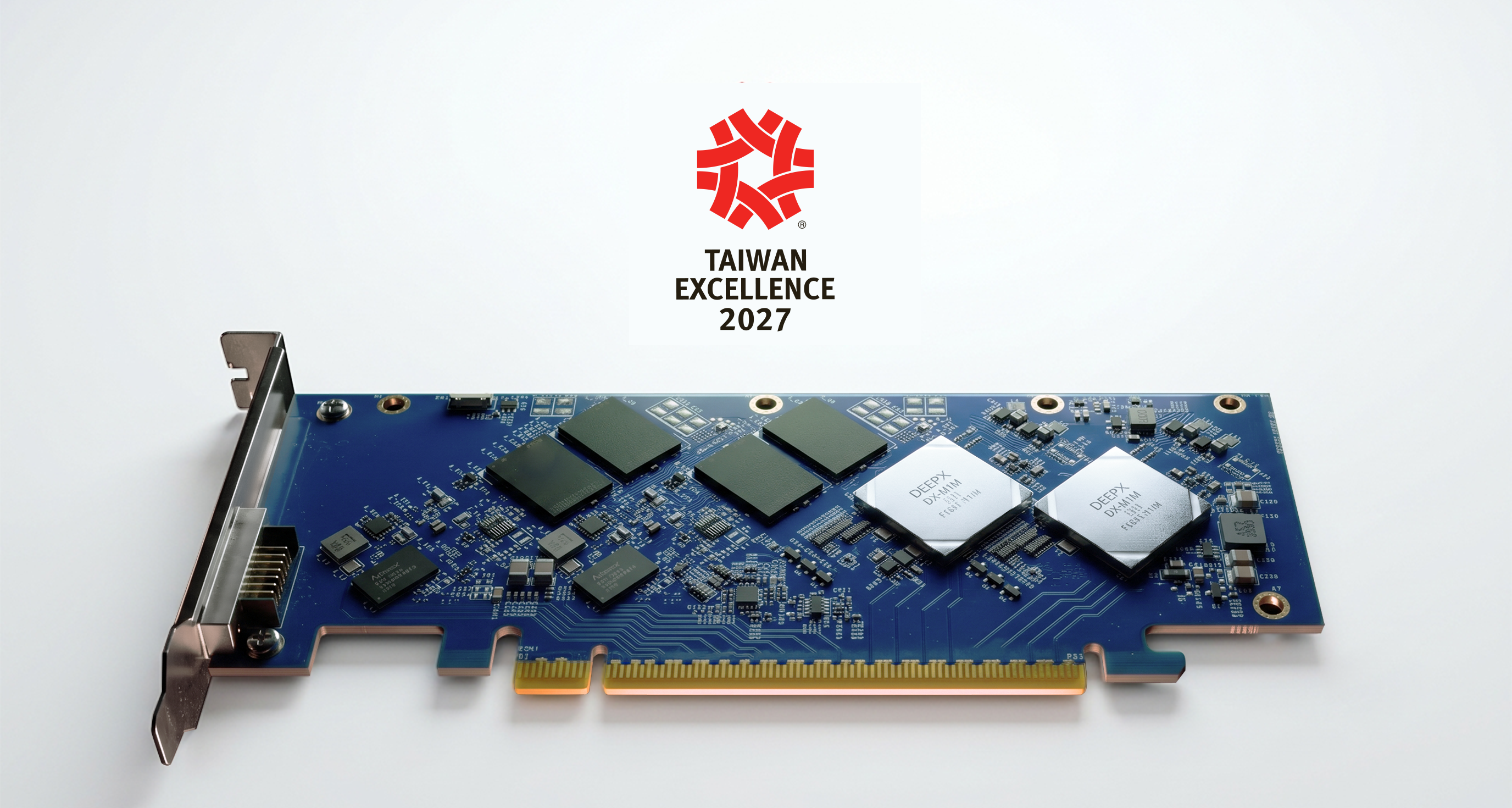
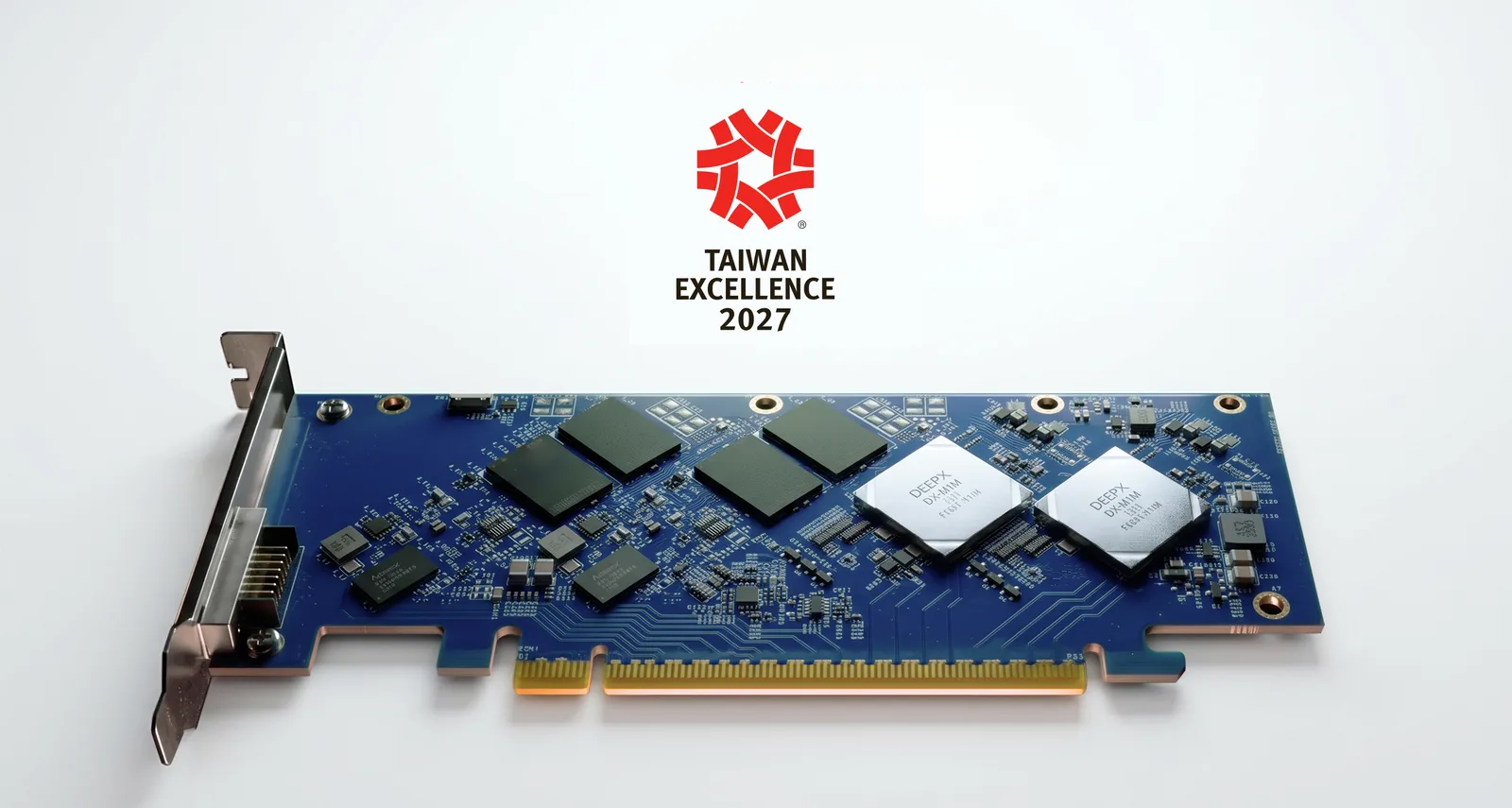
Apacer's ViClaw, Powered by DEEPX NPUs, Wins 2027 Taiwan Excellence Award
Apacer's ViClaw, an edge AI system built with two DEEPX NPUs, has won a 2027 Taiwan Excellence Award.
DEEPX's Next-Generation DX-M2 AI Chip Wins CES 2027 Innovation Award in Artificial Intelligence
DEEPX's DX-M2, a next-generation generative AI chip built on Samsung's 2nm process, won a CES 2027 Innovation Award in the Artificial Intelligence category.